I started a new Weblog that is more directly related to the interactions of my mother and myself and our current journey.
To read the book in progress go to Caregiver: the Book.
Health and wellnessWeblog
Thursday, December 28, 2006
Keeping Time with Alzheimer's
This is an excellent article that can be read in its entirety at the Alzheimer's Reading Room.
"When guilt catches up with me, I am on the bike path above the creek, ducks swimming along beside me. Guilt rolls off our backs like you know what. Alone at last, I walk at my own pace. Fast. Fast is what Ben can no longer do -- and fast is slow compared with the woman coming toward me as I near the marsh. She is wearing shorts and earphones. She smiles and I smile back. What a good idea this is, walking out in the sun and cold. What could produce better clarity? I don't have to work it out the first day. I don't have to do it right the first time."
"When guilt catches up with me, I am on the bike path above the creek, ducks swimming along beside me. Guilt rolls off our backs like you know what. Alone at last, I walk at my own pace. Fast. Fast is what Ben can no longer do -- and fast is slow compared with the woman coming toward me as I near the marsh. She is wearing shorts and earphones. She smiles and I smile back. What a good idea this is, walking out in the sun and cold. What could produce better clarity? I don't have to work it out the first day. I don't have to do it right the first time."


Tuesday, December 19, 2006
Alzheimer’s Disease--What is it?
 Alzheimer's disease is the most common cause of a condition called dementia. It is named for the German doctor who first described it, Alois Alzheimer. What is it? Who gets it? What causes it?
The desciption below was taking from the Milton S. Hershey Medical Center website. This is useful to clear up some of the misunderstanding about the Alzherimer's Disease.
Alzheimer’s Disease
What is it?
Alzheimer's disease is the most common cause of a condition called dementia. Dementia is a general decline in mental ability, such as memory, language skills, judgment, and concentration. Alzheimer’s is a progressive disease, which means symptoms occur gradually and become worse over time. It is named for the German doctor who first described it, Alois Alzheimer.
Who gets it?
Alzheimer’s disease affects most commonly affects those over the age of 65, although it has been diagnosed in people in their 40s and 50s.
What causes it?
The degeneration of parts of the brain, which destroys brain cells, causes the symptoms of Alzheimer’s. However, at this time researchers are not sure what causes this degeneration. Those with a family history of Alzheimer’s are more likely to develop the disease as they age, so there is a gene abnormality that causes the disease in some people. Researchers are looking for links between Alzheimer’s disease and the environment, lifestyle, nutrition, and viruses.
What are the symptoms?
Alzheimer’s usually progresses in three stages, with each lasting anywhere from one to several years. The first symptom of Alzheimer’s disease is usually mild forgetfulness. Someone in the early stages may find him or herself unable to find the right word, recall where something was placed, or recall someone’s name. It may be difficult to concentrate. At this point, symptoms are so general that they do not signal a serious problem or have a great impact on day-to-day functioning. As the disease progresses to the second stage, the forgetfulness becomes worse, making it difficult to function at work, remember directions, or to even make it through the day without difficulty. The person may be restless and unable to sleep at night. His or her personality may change considerably, with increasing anxiety and decreasing emotions. By the late stages of Alzheimer’s, patients suffer from extreme confusion and memory loss. They are unable to recall the names of close friends and family or recent events, and cannot function socially or perform basic daily personal care. Late-stage Alzheimer’s patients may have hallucinations and delusions.
How is it diagnosed?
Alzheimer’s disease is diagnosed by taking a complete medical history and performing a thorough physical examination. Alzheimer’s is generally suspected when there is a gradual deterioration in mental ability. The doctor will perform tests, such as blood tests and brain scans, to rule out other possible causes of the symptoms. The doctor will also ask the patient a series of questions to test his or her mental status. One type of test of mental status is called neuropsychological testing, which is a standardized test of memory, concentration, and visual-spatial skills. Because a definite diagnosis can only be made by performing an autopsy after death, patients are diagnosed with “probable” Alzheimer’s. An autopsy of brain tissue, however, will show areas of abnormal tissue, called plaques, made up of abnormal proteins; a loss of nerve cells; and areas of tangles in the nerve cells that remain in patient’s with Alzheimer’s disease.
What is the treatment?
At this time, there is no cure for Alzheimer’s disease. Treatment focuses on maintaining the best possible quality of life for the patient by providing a supportive environment. Memory aids, such as calendars and other daily reminders of time and place, can help the patient feel more secure and reduce confusion. There are some medications that, when used in the early stages of this disease, can slow memory loss in some patients for a limited amount of time. However, these drugs are used with caution because of potential side effects. Other drugs may be prescribed to treat anxiety, sleeplessness, depression, and hallucinations, as necessary. In the early stages of Alzheimer’s, it is important to help the patient maintain as much independence as possible. As the disease progresses, it may be necessary to seek the help of a home healthcare aid, an adult daycare, or nursing home. While there is currently no treatment to prevent or stop the progression of Alzheimer’s, researchers are continuing to study this disease and test new drugs. There is a possibility that certain types of nonsteroidal anti-inflammatory drugs (NSAIDs) may slow the progression of Alzheimer’s.
Self-care tips
A diagnosis of probable Alzheimer’s is devastating for someone who has been accustomed to living an independent life. It is important to provide the patient with emotional and physical support as he or she adjusts to living with this disease. Keeping the daily routine consistent and as stress free as possible is helpful. Because depression is so common in the early stages of Alzheimer’s, you should be aware of the signs of depression and seek help for the patient as soon as possible. Caring for someone with Alzheimer’s can be demanding and discouraging, especially when the loved one does not remember who you are. Your doctor or local social services agency can direct you to support services to help make this time a little easier. Also seek legal advice so it is clear who has the power to make medical and financial decisions once your loved one is no longer able to do this for him or herself. If you have a family history of Alzheimer’s disease, see your doctor for regular checkups. An early diagnosis is important, especially as the medical community learns more about this disease and its treatment. While there is no way to prevent this disease, you can lower your risk and protect yourself from many illnesses by following a healthy diet that is high in fiber and antioxidants and low in saturated fat, and participating in regular physical exercise. Performing activities that stimulate your brain on a regular basis, such as crossword puzzles, word searches, or memory games, may also help maintain mental ability longer.
--------------------------------------------------------------------------------
This information has been designed as a comprehensive and quick reference guide written by our health care reviewers. The health information written by our authors is intended to be a supplement to the care provided by your physician. It is not intended nor implied to be a substitute for professional medical advice.
Monday, December 18, 2006
Robert T DeMarco

You can read all my blogs at the Robert T DeMarco Weblog. Just click on my name in the subject box above to visit that website.
Bob DeMarco
Tuesday, December 12, 2006
Alzheimer's Reading Room: I'm 45 years old, I can't have Alzheimer's
James Smith remembers the utter shock of hearing his diagnosis.
Click to watch the video, Early diagnosis of Alzheimer's on the Rise
The CareGiver Blog
Robert T DeMarco
AllAmerican Senior Care
AllAmerican Senior Care Weblog
Senior CareElder CareCareGiver Alzheimer’sDementia CareGiver
Click to watch the video, Early diagnosis of Alzheimer's on the Rise
The CareGiver Blog
Robert T DeMarco
AllAmerican Senior Care
AllAmerican Senior Care Weblog
Senior CareElder CareCareGiver Alzheimer’sDementia CareGiver
Saturday, December 09, 2006
Valsartin (Diovan) May Offset Alzheimer's Complication
The drug, valsartin (Diovan), is widely prescribed to treat high blood pressure in elderly patients and was identified as being effective in preventing the build-up of beta-amyloid in the brain.
This article discusses the possibility that drugs currently being used to counter hypertension may help prevent cognitive decline. To read the article in its entirity follow the link,
Blood Pressure Drug May Offset Alzheimer's Complication.
Health and wellnessWeblog
This article discusses the possibility that drugs currently being used to counter hypertension may help prevent cognitive decline. To read the article in its entirity follow the link,
Blood Pressure Drug May Offset Alzheimer's Complication.
Health and wellnessWeblog
Friday, December 01, 2006
My Mother the Dynamo, 2
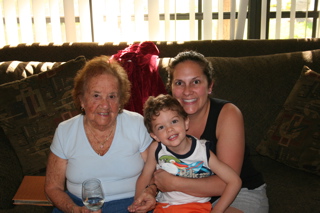
This is a picture of my mother Dorothy who is 90 years young, Kristen my mother's granddaughter, and Ryan her greatgrandson.
This picture was taken at the Banana Boat in Boynton Beach Florida, May, 2006.
Health and wellnessWeblog
Subscribe to:
Posts (Atom)